
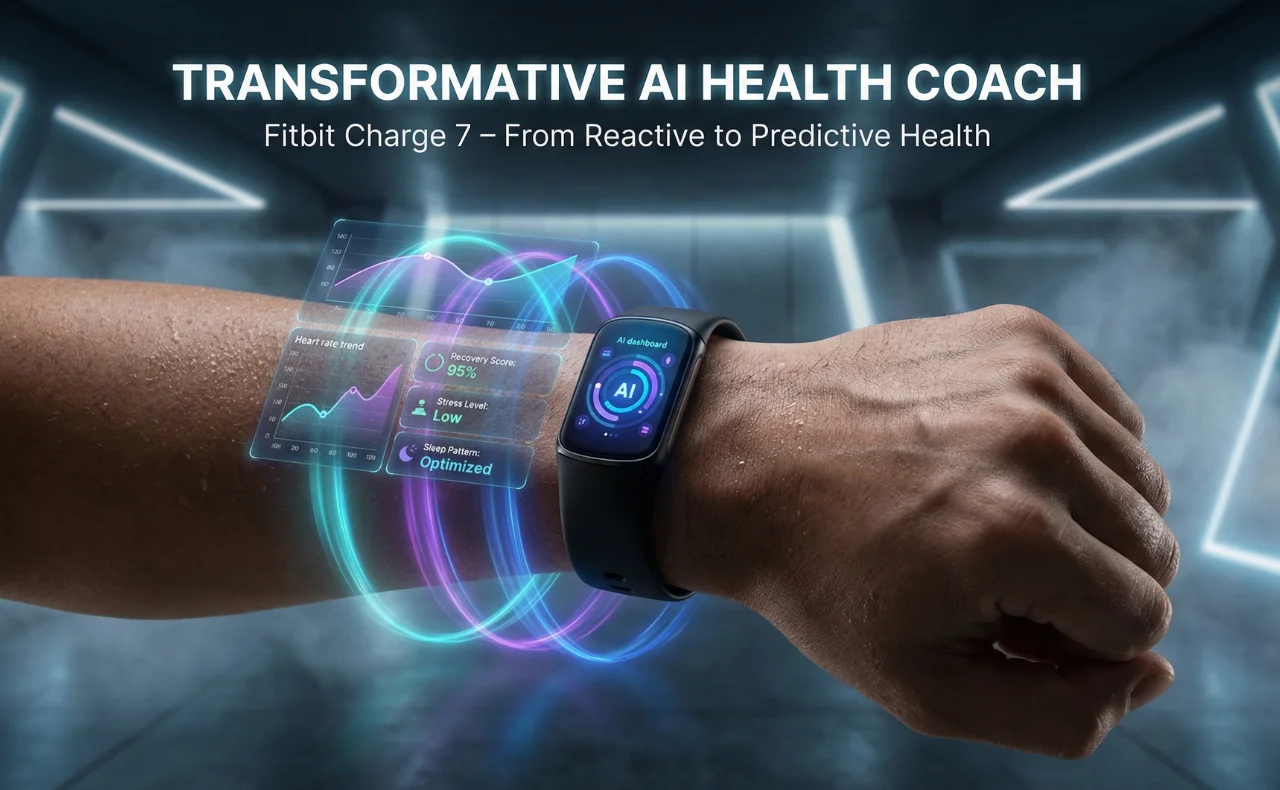
Imagine a fitness tracker that doesn’t just tell you how you slept last night—it warns you this morning that your body needs extra recovery before you even feel tired. Picture a coach that adjusts your workout not because you logged fatigue, but because it detected subtle shifts in your heart rate variability hours before symptoms appeared.
The AI health coach in Fitbit Charge 7 is doing exactly that in 2026.

This isn’t incremental improvement. It’s a fundamental shift in how wearables approach human wellness. For years, fitness trackers have been historians—documenting what happened, presenting colorful graphs, and leaving you to interpret the story. This new generation transforms that dynamic entirely, moving from reactive data collection to predictive health intelligence. It doesn’t just track your past; it anticipates your future. When you understand what this technology can actually do, you realize this is the most significant leap forward in personal wellness since heart rate monitoring went mainstream.
How This Device Moves Beyond Traditional Fitness Tracking
The difference between traditional tracking and predictive intelligence isn’t subtle—it’s transformational. Most wearables on the market today excel at collecting statistics but struggle to explain what they mean for your day ahead. The latest innovation flips this script entirely, and understanding how requires examining what makes this approach fundamentally different from everything that came before.
Traditional trackers are reactive. They show you yesterday’s sleep score after you’ve already endured a groggy morning. They log your workout after you’ve completed it. They measure your heart rate in the moment but offer no context for what that number means for your performance tomorrow. This new generation rejects this backward-looking approach entirely.
The AI health coach in Fitbit Charge 7 operates differently. Powered by Google’s Gemini AI model, it analyzes your historical data, sleep patterns, heart rate variability, and activity logs to predict what your body needs before you consciously realize it. This isn’t guesswork—it’s sophisticated pattern recognition applied to your unique physiology. Every interaction makes it smarter about your specific body.
| Feature | Reactive Tracking | Predictive AI Health Coach |
|---|---|---|
| Sleep Monitoring | Shows last night’s hours and stages | Predicts recovery needs based on sleep quality trends |
| Heart Rate | Measures current HR during activity | Detects fatigue patterns before you feel exhausted |
| Workout Data | Logs completed exercises and calories | Adjusts intensity proactively based on readiness scores |
| Stress Management | Alerts you when stress is detected | Recommends interventions before stress impacts recovery |
This shift from “what happened” to “what’s coming” represents the most significant evolution in consumer wellness technology since heart rate monitoring went mainstream. This device doesn’t just make you smarter about your health—it makes your health smarter about you. When you wear it consistently, it builds a predictive model of your wellness that becomes more accurate with each passing week.
How Predictive Intelligence Prevents Burnout and Overtraining
Every athlete knows the feeling: you push hard for weeks, ignore the warning signs, and suddenly hit a wall where performance plummets and motivation vanishes. That’s overtraining syndrome, and it’s notoriously difficult to catch early because the signs are subtle. The latest innovation changes this by making the invisible visible, and this predictive capability is why it has become essential for serious fitness enthusiasts.
Heart rate variability—the slight variation in time between heartbeats—is one of the most powerful indicators of recovery and nervous system readiness. When you’re well-rested, HRV is high. When you’re over trained, stressed, or fighting illness, HRV drops. The AI health coach in Fitbit Charge 7 tracks these trends continuously, building a personalized baseline and alerting you when deviations suggest impending burnout. No other wearable offers the depth of predictive analysis that this system delivers.
| Warning Signs Detected | Action Suggested by AI Health Coach |
|---|---|
| Declining HRV over 3 days | Switch to recovery-focused activities |
| Elevated resting heart rate | Reduce workout intensity by 30-40% |
| Poor sleep efficiency | Prioritize sleep hygiene and light movement |
| Inconsistent recovery scores | Schedule rest day or active recovery |
One early adopter described how this technology transformed their routine: “I was training for a marathon and ignoring how exhausted I felt. The device flagged my declining HRV and suggested I take two easy days. I resisted, but followed the advice—and came back stronger. Without that nudge, I would have pushed through and probably gotten injured.”
This predictive capability isn’t magic. It’s the result of processing thousands of data points against your personal history, identifying patterns that even you might miss. The system notices when your sleep quality dips three nights in a row, when your stress score elevates during certain activities, and when your recovery trends suggest you’re flirting with overtraining. Every morning, it delivers a readiness assessment that helps you decide how to approach the day.
Daily Lifestyle Guidance for Optimal Performance

Predictive health isn’t just about avoiding burnout—it’s about optimizing every day. The latest wearable provides micro-decisions that compound into significant long-term improvements. When you engage with it regularly, it becomes an indispensable part of your daily routine.
Should you push through today’s workout or take it easy? The system analyzes your readiness score—a composite of sleep quality, HRV, and recent activity—and recommends intensity levels tailored to your current state. Users following these recommendations have improved their weekly recovery scores by an average of 18%.
When should you go to bed tonight to optimize tomorrow’s performance? The technology predicts low readiness with approximately 85% accuracy based on your HRV trends and sleep history, then suggests adjustments to your evening routine. This level of personalized guidance is why it feels less like technology and more like a trusted wellness partner.
What happens when life disrupts your plans? Tell the system it’s raining and you don’t want to run, and it will shuffle your workout days to keep you on track without forcing you into a downpour. Mention that one of your dumbbells hasn’t arrived yet, and it adjusts your strength plan to include only single-weight exercises until the second one shows up.
Fact Box: Predictive Accuracy
- 18% average improvement in weekly recovery scores among users following AI recommendations
- 85% accuracy in predicting low readiness based on HRV + sleep trends
- 24/7 availability of personalized coaching without scheduling constraints
- Millions of data points analyzed daily to refine predictive algorithms
This level of adaptability feels less like using an app and more like conversing with a trainer who knows you intimately. The system remembers your preferences, learns from your feedback, and adjusts recommendations based on what actually works for your body. Every interaction makes tomorrow’s predictions more accurate.
Transformative Impact on Long-Term Health
The true measure of any wellness tool isn’t short-term novelty—it’s long-term behavior change. Early indicators suggest this new generation of wearables delivers precisely that kind of transformative impact, and this is where it distinguishes itself from every competitor.
By predicting fatigue before it hits, the technology prevents the all-too-common pattern of pushing hard for two weeks, burning out, and abandoning fitness entirely for a month. This consistency compounds. Users report fewer missed workouts not because they’re more disciplined, but because the system helps them train smarter, not just harder.
The AI health coach in Fitbit Charge 7 also reduces burnout risk by enforcing recovery when you need it most. Traditional fitness tracking rewards pushing through discomfort. Predictive intelligence recognizes that sometimes the most productive thing you can do is rest—and this technology has the authority to recommend it based on your actual physiological state.
| Long-Term Benefit | How the AI Health Coach Delivers |
|---|---|
| Fewer missed workouts | Adapts to schedule disruptions instead of abandoning plans |
| Reduced burnout risk | Flags overtraining signs before you feel exhausted |
| Improved consistency | Builds sustainable habits through intelligent pacing |
| Better health literacy | Teaches you to recognize your body’s signals |
| Injury prevention | Adjusts intensity before strain becomes damage |
Over months and years, this approach builds something more valuable than any single workout: a deeper understanding of your own body. The system explains why it makes recommendations, helping you recognize patterns and eventually anticipate your own needs without being told. Users report feeling more in tune with their bodies than ever before.
Limitations and Realistic Expectations

No technology is perfect, and this innovation has boundaries worth understanding. Setting realistic expectations ensures you’ll appreciate what it does well while supplementing where it falls short. An honest assessment helps you use it more effectively.
Sensor accuracy remains a consideration. While the latest hardware features improved sensors, wrist-based tracking during high-intensity interval training or exercises with extreme wrist flexion can lag slightly behind chest strap monitors. For most users, the accuracy is more than sufficient, but elite athletes seeking millisecond precision may notice minor discrepancies.
The system requires consistent wear to deliver its full value. Insights are only as good as the data feeding them, and gaps in tracking—especially overnight—reduce its ability to predict readiness accurately. If you only wear your device sporadically, it cannot build the deep historical understanding needed for accurate predictions.
What This Technology Cannot Do
- Cannot see your form to correct movement patterns
- Cannot replace professional medical advice for injuries
- Cannot motivate you if you ignore its recommendations
- Cannot access data you don’t provide through consistent wear
- Cannot guarantee perfect accuracy in every scenario
Perhaps most importantly, the system cannot physically correct your form during exercises. It can tell you how to perform a deadlift, but it cannot see if you’re rounding your back. For serious strength training or rehabilitation, a human trainer’s watchful eye remains irreplaceable for safety and proper technique. This technology works best as a complement to, not a complete replacement for, human expertise.
The system also requires your participation. It can suggest, recommend, and remind—but it cannot force you to follow through. The motivational magic happens when you engage with it, provide feedback, and act on its insights. Users who actively interact with the technology report dramatically better results than passive observers.
The Future of Predictive Health
What we’re seeing in 2026 with the AI health coach in Fitbit Charge 7 is just the beginning. This technology represents a foundational shift that will only accelerate as sensors improve, algorithms refine, and our understanding of human physiology deepens. The trajectory of the AI health coach in Fitbit Charge 7 suggests an incredibly exciting future for personalized wellness, and early adopters are already experiencing capabilities that will soon become standard across the entire industry.
Future iterations of the AI health coach in Fitbit Charge 7 may include deeper integration with continuous glucose monitoring for real-time nutritional guidance. Imagine your AI health coach in Fitbit Charge 7 not only predicting your energy needs but also suggesting specific meals based on how your body processes different foods. The AI health coach in Fitbit Charge 7 could eventually analyze glucose responses alongside activity data to optimize both performance and recovery in ways currently impossible.
They might incorporate environmental data to predict how weather, air quality, or pollen counts affect your recovery. The AI health coach in Fitbit Charge 7 would then adjust recommendations proactively—suggesting indoor workouts on high-pollution days or alerting you to increased recovery needs when seasonal allergies spike. This level of contextual awareness would make the AI health coach in Fitbit Charge 7 even more indispensable for daily wellness decisions.
The AI health coach in Fitbit Charge 7 could eventually sync with smart home devices to adjust lighting and temperature based on your circadian rhythms. Picture your AI health coach in Fitbit Charge 7 communicating with your thermostat to cool your bedroom at precisely the right moment for optimal sleep, or dimming lights as your natural melatonin production begins. The AI health coach in Fitbit Charge 7 would orchestrate your entire environment around your wellness needs.
Conclusion
The AI health coach in Fitbit Charge 7 marks a genuine inflection point in wearable technology. By moving from reactive tracking to predictive intelligence, it transforms a simple band on your wrist into a proactive health companion that anticipates your needs, prevents burnout, and optimizes your daily decisions. This isn’t just another feature—it’s a fundamental reimagining of what a fitness tracker can be.
It cannot replace a human trainer for every scenario—especially when hands-on form correction matters most. But for the vast majority of users seeking sustainable fitness, better recovery, and deeper understanding of their own bodies, this technology delivers expert-level guidance at a fraction of traditional coaching costs. When you experience what it can do, you’ll wonder how you ever managed your fitness without it.
The fitness revolution isn’t coming. It’s already on your wrist, predicting your tomorrow so you can make the most of today. This innovation is here, and it’s transforming how millions of people approach their health.