
Fitbit Sleep Score Accuracy: Can You Trust Your Sleep Data in 2026?

Fitbit Sleep Score is one of the most useful sleep-tracking features available in a consumer fitness tracker. It estimates your overall sleep quality by analyzing sleep duration, sleep stages, heart rate, and overnight body movement. While Fitbit provides reliable insights for tracking sleep trends over time, it is not a medical-grade device and should not be used to diagnose sleep disorders. For most users, the Sleep Score is an excellent tool for building healthier sleep habits, especially when viewed consistently rather than focusing on a single night’s results.
- What Is Fitbit Sleep Score?
- How Fitbit Calculates Sleep Score
- Is Fitbit Sleep Score Accurate?
- Scientific Research Behind Fitbit Sleep Tracking
- Fitbit vs Apple Watch
- Fitbit vs Garmin
- Fitbit vs Oura Ring
- What Can Reduce Fitbit’s Accuracy?
- Tips to Improve Fitbit Sleep Tracking
- Is Fitbit Premium Worth It?
- Frequently Asked Questions
- Final Verdict
What Is Fitbit Sleep Score?
Sleep plays a vital role in physical recovery, mental performance, immune function, and overall health. While many people know how many hours they sleep, they often don’t know how well they actually sleep. Fitbit Sleep Score was designed to solve that problem.
Instead of simply recording the number of hours spent in bed, Fitbit analyzes multiple health signals collected throughout the night and converts them into a single score ranging from 1 to 100.
The higher the score, the better your sleep quality.
Generally speaking:
| Sleep Score | Meaning |
|---|---|
| 90–100 | Excellent sleep quality |
| 80–89 | Good sleep |
| 70–79 | Fair sleep |
| Below 70 | Needs improvement |
Rather than relying on one measurement, Fitbit combines several physiological metrics to estimate how restorative your sleep was.
These include:
- Total sleep duration
- Time spent in Light Sleep
- Time spent in Deep Sleep
- Time spent in REM Sleep
- Resting Heart Rate
- Overnight movement
- Heart Rate Variability (supported devices)
- Blood Oxygen trends (supported devices)
The goal isn’t simply to tell you how long you slept. Instead, Fitbit attempts to answer a more meaningful question:
“How well did your body recover while you were asleep?”
Components of Fitbit Sleep Score
1. Sleep Duration
The most important factor is the total amount of sleep you get.
Most healthy adults benefit from around seven to nine hours of sleep each night. Sleeping significantly less or more than your body’s needs may lower your Sleep Score.
Fitbit measures:
- Total sleep time
- Time awake
- Sleep efficiency
- Bedtime consistency
Longer sleep alone doesn’t guarantee a high score. Quality matters just as much.
2. Sleep Stages
Throughout the night, your brain cycles through different sleep stages.
Fitbit estimates how much time you spend in:
Light Sleep
Light sleep helps prepare your body for deeper recovery.
Deep Sleep
Deep sleep is essential for:
- Physical recovery
- Muscle repair
- Immune system support
- Growth hormone release
Too little deep sleep often reduces your overall Sleep Score.
REM Sleep
Rapid Eye Movement (REM) sleep is associated with:
- Memory formation
- Emotional processing
- Learning
- Brain recovery
Healthy REM cycles contribute significantly to a better Sleep Score.
3. Restoration
Restoration refers to how well your heart slows down during sleep.
Fitbit compares your overnight resting heart rate with your normal baseline.
If your heart remains elevated throughout the night, it may indicate:
- Stress
- Illness
- Alcohol consumption
- Poor recovery
- Overtraining
Better overnight recovery generally results in a higher score.
4. Restlessness
Fitbit also tracks body movement during sleep.
Frequent tossing and turning may suggest:
- Discomfort
- Interrupted sleep
- Poor sleep quality
- External disturbances
Less movement usually indicates more restful sleep.
5. Blood Oxygen Trends (Supported Models)
Certain Fitbit devices monitor overnight oxygen variation.
While this feature cannot diagnose medical conditions, unusual oxygen fluctuations may indicate that your sleep quality was disrupted.
This metric contributes additional context rather than determining your Sleep Score on its own.
How Fitbit Calculates Sleep Score
Although Fitbit does not publicly disclose every detail of its proprietary algorithm, the company explains that Sleep Score combines multiple health signals into a single easy-to-understand number.
Instead of focusing on one night’s sleep duration alone, Fitbit evaluates several factors together.
Sleep Duration
This represents the total amount of time spent asleep compared with your estimated sleep need.
For example:
- Going to bed for eight hours but sleeping only six and a half hours may lower your score.
- Consistently reaching your recommended sleep duration generally improves long-term trends.

Sleep Quality
Sleep quality reflects how effectively your body cycles through different sleep stages.
A healthy balance between Light Sleep, Deep Sleep, and REM Sleep usually produces a stronger Sleep Score than simply sleeping for a long time.
Restoration
Heart rate patterns provide additional insight into overnight recovery.
Fitbit continuously measures heart rate while you sleep to estimate:
- Resting Heart Rate
- Overnight recovery
- Cardiovascular relaxation
If your body recovers efficiently overnight, your Restoration score improves.
Movement During Sleep
Fitbit also evaluates movement patterns.
Frequent interruptions, restless sleep, or repeated awakenings can reduce overall sleep quality, even if total sleep duration appears sufficient.
By combining these measurements, Fitbit generates a single Sleep Score intended to help users identify trends over weeks and months rather than judge their health from one night alone.
Is Fitbit Sleep Score Accurate?
The short answer is yes—but with important limitations.
Fitbit Sleep Score is generally accurate enough to help most people understand their sleeping patterns, identify long-term trends, and improve their sleep habits. However, it should not be considered a replacement for professional medical sleep testing.
Consumer wearables like Fitbit use optical sensors, accelerometers, and proprietary algorithms to estimate sleep. These technologies have improved significantly over the past decade, making devices much better at identifying when users are asleep, awake, or moving during the night.
For healthy adults who want to monitor their overall wellness, Fitbit provides valuable insights. If your Sleep Score consistently declines over several weeks, it may indicate changes in stress, recovery, exercise habits, illness, or bedtime routines.
The greatest strength of Fitbit is trend tracking, not diagnosing medical conditions.
Where Fitbit Performs Well
1. Detecting Sleep and Wake Times
Fitbit is generally effective at estimating when you fall asleep and when you wake up.
By combining wrist movement with continuous heart rate monitoring, the device can identify long periods of sleep with reasonable accuracy for everyday use.
Many users find that Fitbit’s estimated sleep duration closely matches their actual time asleep, especially when they wear the device correctly throughout the night.
2. Monitoring Long-Term Sleep Trends
Rather than focusing on a single night’s data, Fitbit excels at identifying patterns over time.
For example, you may notice:
- Better Sleep Scores after regular exercise.
- Lower scores following late-night meals.
- Reduced recovery during stressful weeks.
- Improvements after establishing a consistent bedtime.
These long-term trends are often more meaningful than one isolated Sleep Score.

3. Heart Rate Monitoring During Sleep
Modern Fitbit devices continuously record heart rate while you sleep.
This information helps estimate:
- Overnight resting heart rate.
- Recovery quality.
- Sleep restoration.
- General cardiovascular trends.
An unusually elevated sleeping heart rate may indicate fatigue, illness, dehydration, or increased stress. Watching these changes over time can help users understand how lifestyle choices affect recovery.
4. Sleep Stage Estimation
Fitbit estimates the amount of time spent in:
- Light Sleep
- Deep Sleep
- REM Sleep
These estimates are based on heart rate patterns and body movement rather than direct measurement of brain activity.
While Fitbit can provide a useful approximation, the exact duration of each sleep stage may differ from results obtained during a clinical sleep study.
Where Fitbit Has Limitations
Even though Fitbit performs well for everyday wellness tracking, several limitations are important to understand.
It Cannot Diagnose Sleep Disorders
Fitbit is designed as a consumer wellness device.
It cannot diagnose conditions such as:
- Sleep apnea
- Insomnia
- Narcolepsy
- Restless Legs Syndrome
- Other clinical sleep disorders
If you experience persistent fatigue, loud snoring, breathing interruptions, or excessive daytime sleepiness, consult a qualified healthcare professional instead of relying solely on wearable data.
Sleep Stage Estimates Are Not Exact
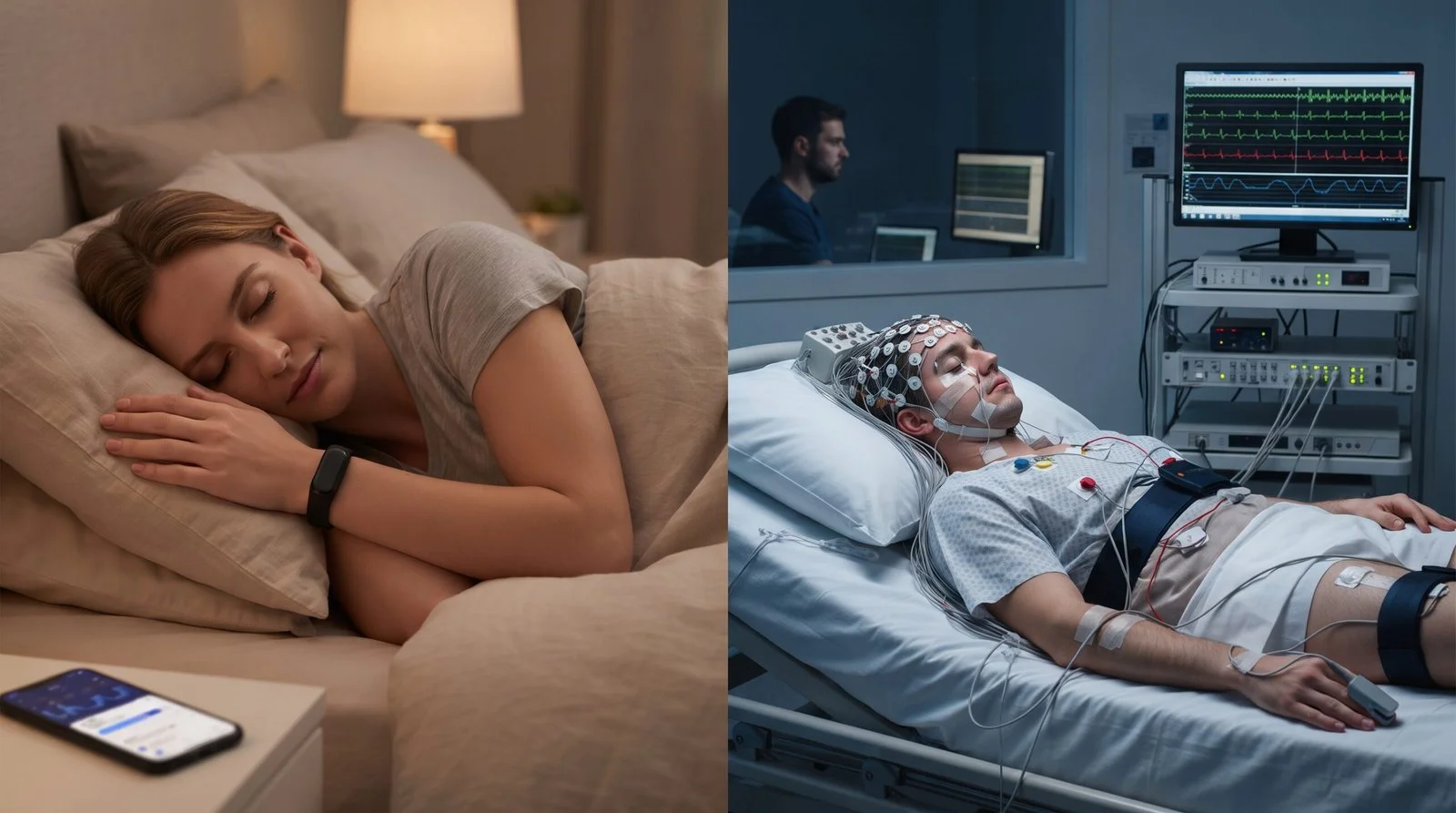
The only way to measure sleep stages with high clinical accuracy is through polysomnography (PSG), a comprehensive sleep study performed in a medical laboratory.
PSG records:
- Brain waves (EEG)
- Eye movements
- Muscle activity
- Breathing patterns
- Oxygen levels
- Heart rhythm
Because Fitbit does not measure brain activity directly, it estimates sleep stages using indirect physiological signals. As a result, occasional differences between Fitbit estimates and laboratory results are expected.

Wrist Placement Matters
A loose or improperly positioned Fitbit can reduce measurement quality.
For the best results:
- Wear the band snugly but comfortably.
- Position it slightly above the wrist bone.
- Avoid excessive movement between the sensor and your skin.
Even small changes in fit can affect heart rate detection and, consequently, your Sleep Score.
External Factors Can Affect Accuracy
Several everyday factors may influence Fitbit’s measurements, including:
- Alcohol consumption before bed.
- Caffeine late in the evening.
- High stress levels.
- Intense exercise close to bedtime.
- Illness or fever.
- Sleeping in unusual positions.
- Frequent nighttime awakenings.
These factors may alter heart rate and movement patterns, leading to lower or less consistent Sleep Scores.
Scientific Research Behind Fitbit Sleep Tracking
Fitbit has been evaluated in multiple independent studies comparing consumer wearables with laboratory-based sleep assessments.
Overall, research suggests that Fitbit devices perform well at estimating total sleep duration and identifying sleep versus wake periods in healthy adults. However, accuracy decreases when estimating detailed sleep stages or in people with certain sleep disorders.
Researchers generally agree on several points:
- Fitbit is reliable for monitoring long-term sleep habits.
- Sleep duration estimates are typically closer to clinical measurements than sleep-stage estimates.
- Deep Sleep and REM Sleep classifications should be viewed as approximations rather than exact measurements.
- Performance can vary depending on the Fitbit model, firmware updates, and the individual user.
Because consumer wearables rely on algorithms rather than direct brain-wave monitoring, no smartwatch can currently match the precision of a full overnight sleep study.
Fitbit vs Clinical Sleep Studies
| Feature | Fitbit | Clinical Sleep Study (PSG) |
|---|---|---|
| Total Sleep Time | Good estimate | Medical standard |
| Sleep Stages | Estimated | Directly measured |
| Heart Rate | Continuous | Medical-grade monitoring |
| Brain Activity | Not measured | EEG monitoring |
| Sleep Disorder Diagnosis | No | Yes |
| Home Convenience | Excellent | Requires sleep laboratory |
| Long-Term Trend Tracking | Excellent | Limited to testing sessions |
For most users, Fitbit offers an excellent balance of convenience and useful health insights. However, if a physician suspects a medical sleep disorder, a professional sleep study remains the gold standard for diagnosis.
The key takeaway is that Fitbit is best viewed as a wellness companion. Its greatest value lies in helping you recognize trends, build healthier habits, and monitor changes over time—not in replacing medical evaluation.
Fitbit vs Apple Watch for Sleep Tracking
Both Fitbit and Apple Watch are among the most popular wearable devices for sleep tracking, but they approach sleep monitoring differently. Fitbit focuses on long-term wellness insights and an easy-to-understand Sleep Score, while Apple Watch emphasizes health integration within the Apple ecosystem.
Feature Comparison
| Feature | Fitbit | Apple Watch |
|---|---|---|
| Sleep Score | ✅ Yes | ❌ No native score |
| Sleep Stages | ✅ Yes | ✅ Yes |
| Heart Rate Tracking | Continuous | Continuous |
| Heart Rate Variability (HRV) | ✅ Yes | ✅ Yes |
| Blood Oxygen (Supported Models) | ✅ Yes | ✅ Yes |
| Skin Temperature Trends | Selected models | Selected models |
| Battery Life | 6–10+ days (model dependent) | About 18–36 hours (model dependent) |
| Comfort for Overnight Wear | Excellent | Good |
| Sleep Coaching | Fitbit Premium | Limited in native app |

Accuracy Comparison
Both devices estimate sleep using motion and optical heart-rate sensors. Neither directly measures brain activity, so both provide estimates rather than medical-grade results.
Fitbit’s Sleep Score offers a quick summary of sleep quality, making it easier for users to monitor long-term trends. Apple Watch integrates well with Apple Health and supports third-party sleep apps for users who want more detailed analysis.
Which Is Better?
Choose Fitbit if you:
- Want a simple daily Sleep Score.
- Prefer longer battery life.
- Wear your watch every night.
- Want detailed recovery trends.
Choose Apple Watch if you:
- Already use the Apple ecosystem.
- Prefer advanced health integrations.
- Use multiple health apps.
- Charge your watch regularly.
Fitbit vs Garmin
Garmin wearables are designed primarily for athletes, while Fitbit targets general fitness and wellness users.
Comparison Table
| Feature | Fitbit | Garmin |
|---|---|---|
| Sleep Score | Yes | Yes (supported models) |
| Sleep Stages | Yes | Yes |
| HRV Tracking | Yes | Yes |
| Recovery Metrics | Moderate | Advanced |
| Battery Life | Excellent | Excellent |
| Fitness Training Features | Moderate | Extensive |
| Ease of Use | Beginner-friendly | More advanced |
Garmin provides extensive recovery data for runners, cyclists, and endurance athletes. Fitbit, on the other hand, offers a cleaner interface that is easier for most users to understand.
For users primarily interested in improving sleep habits rather than training performance, Fitbit remains an excellent choice.
Fitbit vs Oura Ring
The Oura Ring is another popular sleep-tracking device that differs significantly from wrist-based wearables.
Comparison Table
| Feature | Fitbit | Oura Ring |
|---|---|---|
| Wear Location | Wrist | Finger |
| Sleep Score | Yes | Yes |
| Sleep Stages | Yes | Yes |
| HRV | Yes | Yes |
| Temperature Trends | Supported models | Yes |
| Battery Life | 6–10+ days | Up to 7 days |
| Display | Yes | No |
| Activity Tracking | Comprehensive | Basic |
Many users find the Oura Ring more comfortable to wear overnight because it sits on the finger instead of the wrist. Fitbit, however, offers a broader set of fitness features, including workouts, GPS on selected models, notifications, and daily activity tracking.
If your primary goal is overall fitness and health, Fitbit offers greater versatility. If your focus is almost entirely on sleep and recovery, the Oura Ring may be worth considering.

What Can Reduce Fitbit Sleep Score Accuracy?
Although Fitbit performs well under normal conditions, several factors can affect the quality of its sleep estimates.
Loose Watch Band
The optical heart-rate sensor needs consistent contact with your skin. A loose band may interrupt signal quality and reduce measurement accuracy.
Recommendation
Wear your Fitbit snugly enough to stay in place without restricting circulation.
Dirty Sensors
Dust, sweat, lotion, and oils can interfere with optical sensors over time.
Clean the back of your Fitbit regularly using a soft, lint-free cloth.
Low Battery
If the battery becomes critically low overnight, sleep tracking may stop before you wake up.
Charging your device before bedtime helps ensure a complete night’s data.
Sleeping Position
Certain sleeping positions can temporarily reduce blood flow or affect sensor contact, leading to occasional gaps in heart-rate measurements.
Changing position naturally during sleep usually resolves this issue.
Excessive Nighttime Movement
Frequent movement can make it more difficult for Fitbit to distinguish between wakefulness and lighter stages of sleep.
This is especially common during stressful periods or when sleeping in unfamiliar environments.
Tattoos and Skin Characteristics
Optical sensors work by detecting changes in blood flow beneath the skin. In some cases, tattoos or other skin characteristics may reduce sensor performance.
The impact varies by individual, and many users experience no noticeable issues.
Software Updates
Fitbit periodically improves its sleep-tracking algorithms through firmware updates.
Keeping your device updated ensures access to the latest improvements and bug fixes.
How to Improve Fitbit Sleep Tracking Accuracy
While no wearable can guarantee perfect results, following a few best practices can improve the consistency of your Sleep Score.
Wear It Correctly
Position the watch slightly above your wrist bone and ensure it fits securely.
Keep Heart Rate Tracking Enabled
Continuous heart-rate monitoring is essential for estimating sleep stages and calculating Sleep Score.
Disabling this feature may reduce the quality of your sleep analysis.
Update Your Fitbit Regularly
Firmware updates often include improvements to sensor performance, algorithm accuracy, and overall stability.
Charge Before Bed
Aim to begin the night with enough battery to last until morning.
Maintain Consistent Sleep Habits
Going to bed and waking up at similar times each day helps both your body and Fitbit recognize more consistent sleep patterns.
Sync Your Device Daily
Regular syncing ensures that sleep data is processed correctly and available in the Fitbit app without delays.

Focus on Trends Instead of One Night
A single poor Sleep Score is rarely cause for concern.
Instead, monitor your average Sleep Score over several weeks. Long-term trends provide a much more meaningful picture of your sleep health than any individual night’s result.
Fitbit’s basic sleep tracking provides useful information without requiring a subscription, but Fitbit Premium can add additional insights depending on your device and plan.
The important distinction is between tracking your sleep and getting deeper interpretation of your sleep data.
Basic Fitbit sleep tracking can provide information such as:
- Sleep duration
- Sleep stages
- Sleep Score
- Sleep schedule
- Sleep trends
Premium features can provide additional analysis, coaching, and longer-term insights on supported devices and plans.
Fitbit Premium may be worthwhile if you:
- Want more detailed sleep analysis.
- Enjoy guided wellness content.
- Want additional health and fitness insights.
- Prefer personalized recommendations.
- Regularly use Fitbit’s broader ecosystem.
However, someone who only wants to know how long they slept and whether their sleep patterns are improving may find the standard Fitbit experience sufficient.
The value therefore depends less on the Sleep Score itself and more on how much additional guidance you want from the Fitbit ecosystem.
What Is a Good Fitbit Sleep Score?
A Sleep Score of 80 or higher is generally considered a strong result within Fitbit’s scoring system.
However, don’t treat 80 as a magic health threshold.
Your score can naturally change from night to night because of:
- Sleep duration
- Sleep timing
- Restlessness
- Heart rate
- Recovery
- Lifestyle factors
A score in the 70s one night doesn’t automatically mean you slept poorly. Similarly, a score in the 90s doesn’t guarantee that every aspect of your sleep was ideal.
The most useful approach is to compare your scores with your own normal baseline.
For example, if your typical score is around 85 and it suddenly drops into the 60s for several nights, that’s more informative than comparing your number with someone else’s score.

Why Is My Fitbit Sleep Score So Low?
A low Sleep Score can result from several factors.
The most common possibilities include:
Not Getting Enough Sleep
Short sleep duration can significantly affect your score.
Frequent Awakenings
Repeated periods of wakefulness may reduce your overall sleep quality.
Increased Restlessness
More movement during the night can affect your estimated sleep pattern.
Elevated Overnight Heart Rate
Your heart rate may remain higher than usual after stress, intense exercise, alcohol, illness, or other lifestyle changes.
Irregular Sleep Schedule
Going to sleep and waking up at dramatically different times can make it harder to maintain consistent sleep patterns.
Poor Sensor Contact
A loose band or poor sensor contact can affect the quality of the data Fitbit collects.
Instead of immediately assuming your Fitbit is wrong, look at several nights of data and compare the results with your normal pattern.
Can Fitbit Detect Sleep Apnea?
Fitbit can provide information that may be relevant to sleep health, but a Fitbit Sleep Score should not be treated as a diagnosis of sleep apnea.
Some Fitbit devices provide features related to breathing or blood oxygen trends. Unusual patterns may be worth discussing with a healthcare professional, particularly if they occur alongside symptoms such as loud snoring, gasping during sleep, or excessive daytime sleepiness.
A medical professional can determine whether further testing is appropriate.
A wearable can be useful for raising questions about your sleep. It should not be used to independently diagnose a sleep disorder.
Does Fitbit Overestimate Sleep?
Fitbit can sometimes classify periods of quiet wakefulness as sleep.
This is a known challenge for wrist-based sleep trackers because the device primarily relies on indirect signals such as movement and heart-rate patterns.
For example, if you’re lying still in bed while thinking, reading, or resting, your Fitbit may potentially interpret some of that period as sleep.
This is one reason why estimated sleep duration should not be treated as an exact measurement.
The best way to use the information is to look at repeated patterns.
If Fitbit consistently records substantially more sleep than you believe you are getting, check:
- Whether the device fits correctly.
- Whether the sleep and wake times are accurate.
- Whether the device software is current.
- Whether the discrepancy continues over multiple nights.
Is Fitbit Better Than Apple Watch for Sleep Tracking?
There isn’t one universal winner.
Fitbit has an advantage for people who want a dedicated Sleep Score, longer battery life, and simple long-term sleep trends.
Apple Watch can be a better choice for users who already rely heavily on Apple Health and want their sleep information integrated with a broader Apple ecosystem.
The choice should therefore depend on your priorities.
Choose Fitbit for:
- Straightforward sleep scoring.
- Longer battery life.
- Easy trend monitoring.
- Fitbit’s wellness ecosystem.
Choose Apple Watch for:
- Apple Health integration.
- Broader smart-watch functionality.
- Third-party health applications.
- Users already invested in Apple’s ecosystem.
Which Fitbit Is Best for Sleep Tracking?
The best Fitbit for sleep tracking depends on the features you need and the model available at the time you purchase.
When comparing Fitbit devices, look for:
- Reliable heart-rate tracking.
- Sleep-stage tracking.
- Comfortable overnight design.
- Sufficient battery life.
- Relevant health sensors.
- Features that match your budget and priorities.
A comfortable device is particularly important.
The theoretically most advanced tracker isn’t useful if you don’t want to wear it while sleeping.
For many people, a lightweight Fitbit that can comfortably remain on the wrist overnight may provide more practical value than a larger device with additional features that they rarely use.
Frequently Asked Questions
Is Fitbit Sleep Score really accurate?
Fitbit Sleep Score can be useful and reasonably reliable for monitoring sleep patterns and trends, but it isn’t a medical-grade measurement. Sleep duration and sleep-versus-wake estimates can be useful, while detailed sleep-stage measurements should be treated as estimates.
What is a good Fitbit Sleep Score?
A score of 80 or above is generally considered good, but your personal baseline matters more than a universal number. Look at your average score and how it changes over time.
Can Fitbit detect sleep apnea?
Fitbit should not be used to diagnose sleep apnea. Certain devices can provide breathing or oxygen-related information that may be useful context, but suspected sleep apnea requires appropriate medical evaluation.
Does Fitbit overestimate sleep?
It can sometimes classify quiet periods of wakefulness as sleep. Wrist-based devices estimate sleep indirectly, so occasional discrepancies are expected.
Is Fitbit better than Apple Watch for sleep?
Fitbit may be preferable if you value a dedicated Sleep Score, longer battery life, and simple sleep trends. Apple Watch may be better for people who prefer Apple’s health ecosystem and broader smartwatch capabilities.
Why is my Fitbit Sleep Score suddenly low?
A sudden decrease can be associated with shorter sleep, more restlessness, changes in sleep timing, elevated overnight heart rate, stress, illness, alcohol, intense exercise, or sensor-related issues.
Look for a pattern across several nights rather than judging your sleep from one score.
Does Fitbit accurately measure REM and Deep Sleep?
Fitbit estimates REM and Deep Sleep using signals such as movement and heart rate. These estimates can be useful for identifying trends, but they should not be considered equivalent to clinical sleep-stage measurements.
Should I trust my Fitbit Sleep Score?
You can use it as a wellness and trend-tracking tool, but don’t treat it as a medical diagnosis. If your Fitbit consistently shows unusual sleep patterns or you have concerning symptoms, discuss them with a healthcare professional.

Key Takeaways
The most important things to remember about Fitbit Sleep Score accuracy are:
1. Fitbit is useful for trends.
Its greatest value is showing how your sleep changes over time.
2. Sleep duration is easier to estimate than sleep stages.
A wearable can estimate when you’re asleep, but it doesn’t directly measure brain activity like a clinical sleep study.
3. One night’s score isn’t everything.
Look at weekly and monthly patterns instead.
4. Wearing the device correctly matters.
A secure, comfortable fit helps the sensors collect more consistent data.
5. Fitbit isn’t a diagnostic device.
Don’t use Sleep Score or wearable measurements to diagnose sleep disorders.
6. Compare yourself with yourself.
Your personal baseline can be more useful than comparing your score with someone else’s.
Final Verdict: How Accurate Is Fitbit Sleep Score?
So, is Fitbit Sleep Score accurate?
For everyday sleep tracking, it’s useful and informative—but it isn’t perfect.
Fitbit does a good job of turning complicated overnight sensor data into an easy-to-understand picture of your sleep. Its biggest strength isn’t necessarily telling you the exact minute you entered REM sleep or precisely measuring every period of Deep Sleep.
Its real strength is helping you recognize patterns.
If your Sleep Score is consistently improving after you establish a regular bedtime, exercise consistently, reduce late-night alcohol, or improve your sleeping environment, that’s valuable information.
Likewise, a persistent decline may encourage you to investigate changes in your lifestyle or overall wellbeing.
The important distinction is between wellness tracking and medical measurement.
A Fitbit is designed to help you understand your habits. A clinical sleep study uses specialized equipment to measure physiological signals directly and is the appropriate tool when a medical sleep disorder needs to be evaluated.
Therefore, don’t ask:
“Was my Fitbit Sleep Score exactly correct last night?”
Instead, ask:
“What is my sleep pattern telling me over the last few weeks?”
That is where Fitbit Sleep Score becomes most useful.
Wear the device consistently, keep it properly positioned, maintain the software, and pay attention to trends rather than obsessing over individual numbers.
And if your sleep remains consistently poor—or you’re experiencing symptoms such as significant daytime sleepiness, loud snoring, or breathing interruptions—use your Fitbit data as conversation material for a healthcare professional rather than as a diagnosis.
Bottom line: Fitbit Sleep Score is best viewed as a convenient sleep-trend and wellness tool, not a replacement for professional sleep testing.
