
Fitbit Sleep Score Explained: What Is a Good Score & How to Improve It (2026 Guide)

Getting enough sleep is important, but sleep duration alone doesn’t tell the whole story. Two people may both sleep for eight hours, yet one wakes up refreshed while the other still feels tired. That’s because sleep quality depends on several factors, including how restorative your sleep was, how often you woke during the night, and how much time you spent in different sleep stages.
Fitbit helps simplify this information by providing a Sleep Score—a single number that summarizes your overnight sleep quality. Instead of manually interpreting multiple sleep metrics, you can use the score as a quick snapshot of how well your body recovered during the night.
Many Fitbit users wonder whether their Sleep Score is “good,” why it sometimes changes dramatically, or what they can do to improve it. Those are reasonable questions, especially when you’re trying to build healthier sleep habits or better understand the insights your wearable provides.
In this guide, you’ll learn what the Fitbit Sleep Score represents, how it is calculated, what different score ranges generally indicate, and practical ways to improve your sleep over time. You’ll also discover common reasons your score may change from one night to the next and how to interpret your results without relying on a single night’s data.
What Is Fitbit Sleep Score?
Fitbit Sleep Score is a feature designed to provide a simple overview of your nightly sleep quality. Rather than focusing only on the number of hours you slept, it combines several sleep-related measurements into a single score, making it easier to track your overall sleep patterns over time.
When you wear a compatible Fitbit device while sleeping, it records information such as your estimated sleep duration, movement during the night, heart-rate patterns, and time spent in different sleep stages. These measurements are then analyzed to produce your daily Sleep Score, helping you understand whether your sleep was generally restorative or if there are areas that could be improved.
One of the biggest advantages of the Sleep Score is that it turns complex sleep data into an easy-to-understand metric. Instead of interpreting multiple graphs and charts every morning, you can quickly see whether your sleep quality improved, remained consistent, or declined compared with previous nights.
However, it’s important to remember that the Sleep Score is intended as a wellness indicator, not a medical diagnosis. Consumer wearables estimate sleep based on sensor data and algorithms, and while they can reveal useful trends, they should not replace professional evaluation for ongoing or severe sleep problems.
Where Can You Find Your Sleep Score?
You can typically view your Sleep Score in the Fitbit app after your device has synchronized your overnight sleep data. The app also provides additional information, including sleep stages, estimated time asleep, and historical trends, allowing you to monitor changes over weeks and months.
Why Tracking Trends Matters
A single night’s Sleep Score can be influenced by many factors, including stress, illness, travel, or an unusually late bedtime. For that reason, it’s generally more useful to monitor your scores over time rather than worrying about one low result. Consistent patterns often provide more meaningful insights into your overall sleep health and can help you identify habits that improve or reduce sleep quality.
How Fitbit Calculates Your Sleep Score
Understanding how Fitbit calculates your Sleep Score can help you make better sense of your nightly results. While the app displays a single number, that score is based on several measurements collected while you sleep. Rather than rewarding only the number of hours you spend in bed, Fitbit looks at multiple indicators that reflect the overall quality and consistency of your sleep.
Although Fitbit does not publicly disclose the exact weighting of every factor in its algorithm, it explains that the Sleep Score is influenced by three primary categories: sleep duration, sleep restoration, and sleep stages. Compatible devices also use heart-rate data and other overnight signals to provide more personalized sleep insights.
Instead of asking, “Did I sleep for eight hours?”, Fitbit tries to answer a more useful question:
“How well did your body recover while you were asleep?”
Sleep Duration
Sleep duration is one of the most important components of your Sleep Score. It measures how long you were actually asleep rather than simply how long you stayed in bed.
For example:
| Time in Bed | Actual Sleep Time |
|---|---|
| 8 hours | 7 hours 20 minutes |
| 7 hours | 6 hours 10 minutes |
If you spend a long time awake during the night, your actual sleep duration decreases, which may lower your overall Sleep Score.
Generally, adults are encouraged to aim for 7–9 hours of sleep per night, but the ideal amount varies between individuals. Fitbit uses your recorded sleep time as one indicator of whether you’re getting enough rest.
Why It Matters
Sleeping for only five or six hours—even if the sleep feels uninterrupted—may reduce your Sleep Score because your body has less time for recovery.
Likewise, sleeping for ten hours doesn’t automatically guarantee a high score if your sleep quality was poor.
Sleep Restoration
Sleep restoration reflects how restful your sleep was, not simply how long you slept.
Fitbit estimates restoration by analyzing patterns such as:
- Restlessness during the night
- Periods of wakefulness
- Overnight heart-rate behavior
- Overall sleep continuity
Someone who sleeps for seven uninterrupted hours may receive a better Sleep Score than someone who sleeps for nine hours but wakes up repeatedly.
Example
Imagine two Fitbit users:
User A
- 7 hours 30 minutes asleep
- Few awakenings
- Stable overnight heart rate
User B
- 8 hours 30 minutes asleep
- Frequent tossing and turning
- Multiple awakenings
Despite sleeping longer, User B may receive the lower Sleep Score because the sleep was less restorative.
This is one reason Fitbit encourages users to focus on sleep quality rather than sleep duration alone.
Sleep Stages
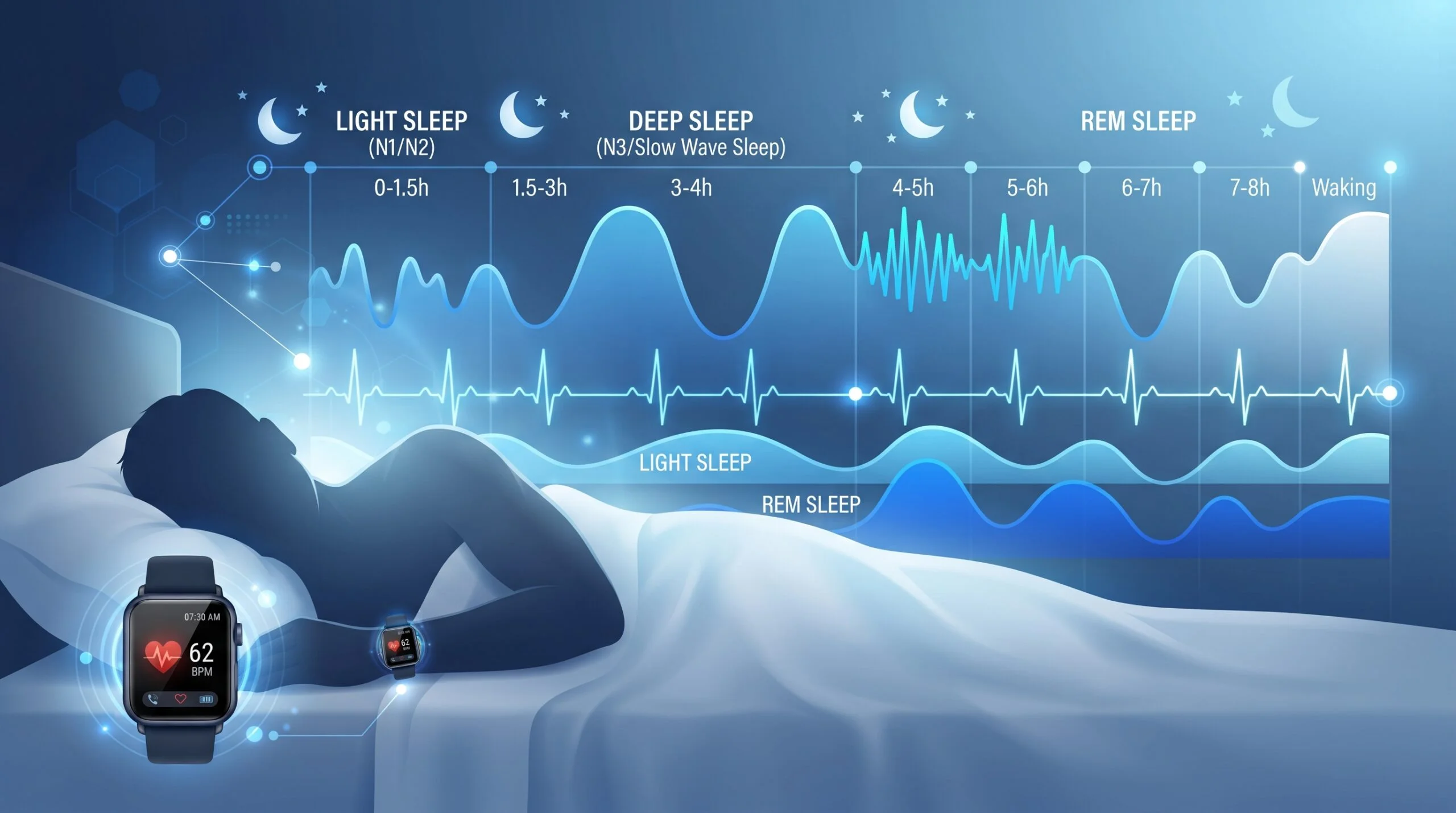
As you sleep, your body cycles through different sleep stages that each play a role in physical recovery and brain function.
Fitbit estimates time spent in:
- Light Sleep – The transition stage where your body begins to relax.
- Deep Sleep – Important for physical recovery, tissue repair, and immune function.
- REM Sleep – Associated with dreaming, memory consolidation, and emotional processing.
A balanced distribution of these stages generally contributes to a healthier sleep profile.
If Fitbit detects unusually low amounts of deep or REM sleep over time, your Sleep Score may reflect those changes.
Why Sleep Stages Matter
Healthy sleep isn’t just about spending more time asleep.
It’s also about allowing your body to complete several full sleep cycles throughout the night.
This is why:
- Seven hours of uninterrupted sleep may produce a better score than eight fragmented hours.
- Consistent bedtimes often support more regular sleep-stage patterns.
- Chronic sleep disruption can affect overall sleep quality even when total sleep time appears adequate.

Overnight Heart Rate
Compatible Fitbit devices monitor your heart rate while you sleep.
During restful sleep, your heart rate typically decreases compared with daytime activity.
Fitbit uses overnight heart-rate trends to help estimate how well your body recovered during the night.
For example, if your resting heart rate remains unusually elevated overnight, it could coincide with:
- Physical stress
- Illness
- Alcohol consumption
- Poor recovery after intense exercise
- Inadequate sleep
One elevated night does not necessarily indicate a problem, but consistent changes over time may influence your Sleep Score and provide useful context for your sleep trends.
Additional Health Signals
Depending on your Fitbit model, additional overnight measurements may contribute to the broader sleep insights available in the Fitbit app.
These may include:
- Blood oxygen (SpO₂) trends
- Skin temperature variations
- Heart rate variability (HRV)
- Breathing patterns
- Long-term sleep trends
These metrics don’t necessarily change your Sleep Score directly in a visible way, but they provide additional context that can help you better understand your overnight recovery and overall wellness.
How the Sleep Score Comes Together
You can think of Fitbit’s Sleep Score as a combination of several related factors rather than a single measurement.
| Component | Why It Matters |
|---|---|
| Sleep Duration | Measures how much sleep you actually got. |
| Sleep Restoration | Estimates how restful and uninterrupted your sleep was. |
| Sleep Stages | Evaluates the balance of light, deep, and REM sleep. |
| Overnight Heart Rate | Indicates how well your body recovered during sleep. |
| Additional Health Signals | Adds context through metrics such as HRV and SpO₂ on supported devices. |
Rather than relying on one metric alone, Fitbit combines these measurements to provide an overall estimate of your nightly sleep quality.
Key Insight
A high Sleep Score isn’t achieved simply by sleeping longer. It reflects a combination of adequate sleep duration, restorative sleep, balanced sleep stages, and healthy overnight physiological patterns. Monitoring these trends over weeks or months is generally more informative than focusing on any single night’s result.
Fitbit Sleep Score Scale Explained
Once you understand how Fitbit calculates your Sleep Score, the next step is learning what the number actually means. A Sleep Score is most useful when you know how to interpret it in the context of your sleep habits, lifestyle, and long-term trends.
While there’s no “perfect” score that everyone should aim for, Fitbit generally groups Sleep Scores into broad ranges that help you understand whether your sleep was restorative or whether there may be room for improvement.
The important thing to remember is that the score is a wellness indicator, not a competition. A score that is slightly lower than usual doesn’t automatically mean something is wrong—it simply suggests that one or more aspects of your sleep may have differed from your typical pattern.
Fitbit Sleep Score Chart
The following chart provides a practical way to interpret your Sleep Score.
| Sleep Score | Quality | What It Generally Means | Suggested Action |
|---|---|---|---|
| 90–100 | Excellent | Highly restorative sleep with strong overall recovery. | Maintain your current sleep routine and healthy habits. |
| 80–89 | Good | Healthy sleep quality with only minor areas for improvement. | Stay consistent and monitor long-term trends. |
| 70–79 | Fair | Sleep was adequate, but factors such as interruptions or reduced deep sleep may have affected recovery. | Review your bedtime routine and identify possible disruptions. |
| Below 70 | Needs Improvement | Sleep quality may have been reduced by stress, illness, inconsistent schedules, or other lifestyle factors. | Look for recurring patterns and consider improving your sleep environment and routine. |
These ranges are intended to help you understand your nightly results, but they should always be interpreted alongside your personal sleep history rather than in isolation.
What Is a Good Fitbit Sleep Score?
One of the most common questions Fitbit users ask is:
What is considered a good Fitbit Sleep Score?
For many users, a score between 80 and 89 generally indicates good-quality sleep. It often reflects a balance of sufficient sleep duration, healthy sleep stages, and relatively restorative sleep.
A score of 90 or above typically represents an excellent night of sleep, where multiple sleep-quality factors aligned well. However, achieving a score above 90 every night isn’t realistic—or necessary—for most people.
Likewise, an occasional score in the 70s isn’t automatically a cause for concern. Temporary factors such as a late bedtime, travel, emotional stress, or recovering from illness can affect your score without indicating a long-term sleep problem.
Why One Night Doesn’t Define Your Sleep Health
Imagine these two examples:
Example 1
Sarah normally sleeps well and records scores around 85–90 throughout the month.
One evening she stays up late for a family event and receives a Sleep Score of 72.
That lower score reflects one unusual night rather than a decline in her overall sleep health.
Example 2
Michael records Sleep Scores between 68 and 72 for several weeks.
Although each score alone isn’t dramatically low, the consistent pattern suggests that his sleep routine may need attention. Reviewing factors such as bedtime consistency, stress levels, or caffeine intake may provide useful insights.
These examples illustrate why long-term trends are generally more meaningful than a single night’s result.
Factors That Can Influence Your Score
Your Sleep Score may increase or decrease because of changes in your daily routine or environment.
Common influences include:
- Going to bed much later than usual.
- Waking up frequently during the night.
- Increased stress or anxiety.
- Alcohol consumption before bedtime.
- Late-evening caffeine.
- Sleeping in an unfamiliar environment while traveling.
- Recovering from illness.
- Intense exercise close to bedtime.
Many of these influences are temporary, which is why occasional fluctuations are normal.
Don’t Compare Your Score With Other People
It can be tempting to compare your Sleep Score with friends, family members, or screenshots shared online, but doing so isn’t particularly useful.
Sleep quality depends on many individual factors, including:
- Age
- Daily activity level
- Lifestyle
- Stress levels
- Existing health conditions
- Personal sleep patterns
Someone else’s score doesn’t necessarily represent what is normal or achievable for you.
Instead, the most valuable comparison is with your own historical data.
If your average Sleep Score gradually improves over several weeks while you also feel more rested during the day, that’s often a stronger indicator of progress than reaching a specific number.
Focus on Trends, Not Perfection
A healthy approach to using Fitbit Sleep Score is to think of it as a long-term wellness tool rather than a nightly report card.
Instead of asking:
- “Why wasn’t my score 90?”
Ask questions such as:
- Has my average score improved over the past month?
- Do I feel more refreshed when my score is higher?
- Which evening habits seem to improve my sleep?
- Are there recurring patterns on low-score nights?
These questions help turn the Sleep Score into actionable information rather than just another statistic.
Quick Summary
A Fitbit Sleep Score provides the most value when viewed over time. While 80–89 is generally considered a good range and 90+ often reflects excellent sleep quality, occasional lower scores are normal. Rather than chasing a perfect number, focus on consistent habits, identify patterns in your sleep data, and use the score as a guide for building a healthier sleep routine.
Why Your Fitbit Sleep Score Changes
Have you ever gone to bed at your usual time but woken up with a Sleep Score that’s much lower—or higher—than expected? That’s a common experience for Fitbit users.
Your Sleep Score isn’t based on just one factor. It’s influenced by your overall sleep quality, nightly recovery, and several lifestyle habits. Even small changes in your routine can affect the measurements your Fitbit records while you sleep.
Understanding why your Fitbit Sleep Score changes can help you identify habits that support better rest instead of worrying about occasional fluctuations.
1. Stress and Mental Well-Being
Stress is one of the most common reasons for a lower Sleep Score.
When you’re stressed, your body may:
- Take longer to fall asleep.
- Wake up more often during the night.
- Spend less time in restorative sleep stages.
- Maintain a higher overnight heart rate.
Even if you stay in bed for eight hours, poor-quality sleep caused by stress may reduce your Sleep Score.
What You Can Do
- Practice relaxation techniques before bed.
- Avoid work-related activities late at night.
- Try deep breathing, meditation, or light stretching.
- Keep a consistent bedtime routine.
2. Illness and Recovery
Your body often needs more rest when you’re sick.
During illness, Fitbit may detect changes such as:
- Elevated overnight heart rate.
- Increased restlessness.
- More frequent awakenings.
- Changes in normal sleep patterns.
As a result, your Sleep Score may temporarily decrease.
This doesn’t necessarily mean you’re sleeping “wrong.” Instead, it often reflects that your body is working to recover.
3. Inconsistent Sleep Schedule
Going to bed at different times every night can disrupt your natural sleep rhythm.
For example:
| Night | Bedtime |
|---|---|
| Monday | 10:30 PM |
| Tuesday | 11:00 PM |
| Wednesday | 2:00 AM |
| Thursday | Midnight |
Large variations like these can affect sleep quality, even if your total sleep time remains similar.
Better Habit
Aim to go to bed and wake up at approximately the same time every day, including weekends whenever possible.
4. Caffeine Late in the Day
Caffeine can remain in your system for several hours.
Late-afternoon or evening consumption may:
- Delay falling asleep.
- Reduce deep sleep.
- Increase nighttime wakefulness.
- Affect overnight recovery.
Some people are more sensitive to caffeine than others, so its impact varies.
Practical Tip
If you notice lower Sleep Scores after drinking coffee or energy drinks later in the day, try reducing or moving your caffeine intake earlier and monitor whether your scores improve over time.

5. Alcohol Before Bed
Many people feel sleepy after drinking alcohol, but that doesn’t necessarily translate to high-quality sleep.
Alcohol may:
- Fragment sleep.
- Reduce restorative sleep stages.
- Increase nighttime awakenings.
- Affect overnight heart-rate patterns.
It’s common for people to see lower Sleep Scores after evenings involving alcohol, even if they slept for several hours.
6. Exercise Timing
Regular physical activity generally supports healthy sleep, but timing can matter.
Earlier Exercise
Often supports:
- Better sleep quality.
- Improved recovery.
- More consistent sleep routines.
Very Late Intense Workouts
May temporarily:
- Increase heart rate.
- Delay relaxation.
- Make falling asleep more difficult for some individuals.
This doesn’t affect everyone the same way, so pay attention to your own sleep trends.
7. Travel and Jet Lag
Travel introduces several factors that can influence your Sleep Score:
- Different time zones.
- Unfamiliar sleeping environments.
- Changes in routine.
- Noise or light disturbances.
- Travel-related stress.
It’s normal for your Sleep Score to fluctuate while traveling. Once your routine stabilizes, your scores often return to their usual range.
8. Sleep Environment
Your bedroom plays a bigger role than many people realize.
A poor sleep environment may include:
- Excessive noise.
- Bright lights.
- Uncomfortable temperatures.
- An unsupportive mattress or pillow.
- Frequent interruptions from pets or other household members.
Creating a cool, dark, and quiet sleep environment can support more restorative sleep.
9. Screen Time Before Bed
Phones, tablets, laptops, and televisions can make it harder for some people to wind down before sleep.
Extended screen use late in the evening may:
- Delay bedtime.
- Reduce relaxation.
- Disrupt a consistent bedtime routine.
Instead of scrolling through your phone immediately before bed, consider reading, stretching, or listening to calming music.
10. One Night Doesn’t Tell the Whole Story
One of the biggest mistakes Fitbit users make is assuming that a single low Sleep Score means something is seriously wrong.
For example:
| Scenario | Possible Impact |
|---|---|
| Stressful workday | Temporary lower score |
| Late-night celebration | Reduced sleep quality |
| Recovering from a cold | Elevated overnight heart rate |
| Long travel day | Disrupted sleep schedule |
| New bedtime routine | Temporary adjustment period |
These situations often produce short-term changes that resolve naturally.
The real value of Fitbit Sleep Score comes from identifying long-term patterns, not reacting to isolated nights.
How to Spot Meaningful Trends
Instead of checking only today’s score, review your sleep data over several weeks.
Ask yourself:
- Is my average Sleep Score improving?
- Do I consistently sleep better on certain days?
- Does late caffeine affect my scores?
- Do stressful weeks reduce my sleep quality?
- Does maintaining a regular bedtime improve my recovery?
These observations are often more useful than chasing a perfect score every morning.
Key Takeaway
Your Fitbit Sleep Score naturally changes because your body, daily routine, and environment also change. Stress, illness, inconsistent bedtimes, caffeine, alcohol, travel, exercise timing, and your sleep environment can all influence your nightly results. Rather than focusing on occasional fluctuations, use your Sleep Score to identify long-term trends and make gradual improvements to your sleep habits.

How Accurate Is Fitbit Sleep Score?
One of the most common questions people ask after checking their Fitbit each morning is:
“Can I trust my Fitbit Sleep Score?”
The short answer is that Fitbit Sleep Score can be a useful indicator of your overall sleep patterns, but it should be viewed as a wellness tool rather than a medical diagnosis. It helps you recognize trends and understand how lifestyle changes may affect your sleep quality, but it cannot provide the same level of detail or precision as a clinical sleep evaluation.
Understanding both the strengths and limitations of Fitbit Sleep Score will help you use the data more effectively and avoid drawing conclusions from a single night’s results.
What Fitbit Measures Well
Fitbit devices use sensors such as the optical heart-rate monitor and motion sensors to estimate your sleep. By analyzing this data throughout the night, the Fitbit app can provide insights into your sleep duration, estimated sleep stages, and overall Sleep Score.
For everyday users, Fitbit is particularly helpful for:
- Tracking how long you sleep.
- Identifying long-term sleep patterns.
- Noticing changes in bedtime consistency.
- Monitoring overnight heart-rate trends.
- Encouraging healthier sleep habits through regular feedback.
If your Sleep Score improves after making lifestyle changes—such as following a more consistent bedtime or reducing late-night caffeine—that trend can be meaningful even if the exact number isn’t perfectly precise.
Where Fitbit Has Limitations
Although Fitbit provides valuable insights, it’s important to understand that it estimates sleep based on wearable sensor data.
Unlike a professional sleep study, Fitbit does not directly measure brain activity. This means that while it can estimate when you’re asleep and identify likely sleep stages, it cannot confirm them with the same level of accuracy as medical equipment.
As a result, Fitbit may occasionally:
- Estimate that you’re asleep when you’re lying still but awake.
- Misclassify certain sleep stages.
- Miss brief awakenings during the night.
- Produce slightly different results from one night to the next.
These limitations are common among consumer wearable devices and don’t necessarily make the data useless. Instead, they reinforce the importance of using the Sleep Score as a guide rather than an absolute measurement.
Fitbit vs. Clinical Sleep Studies
The table below highlights the key differences between a Fitbit Sleep Score and a clinical sleep study.
| Feature | Fitbit Sleep Score | Clinical Sleep Study |
|---|---|---|
| Primary Purpose | Daily wellness tracking | Medical diagnosis |
| Location | Home | Sleep laboratory or approved home study |
| Data Collection | Motion and sensor-based estimates | Brain waves, breathing, oxygen levels, heart rhythm, muscle activity, and more |
| Best For | Monitoring long-term sleep trends | Diagnosing sleep disorders |
| Convenience | High | Moderate to low |
| Medical Diagnosis | No | Yes |
This comparison doesn’t mean one is “better” than the other—they serve different purposes.
For most healthy adults, Fitbit provides enough information to monitor habits and recognize trends. If someone experiences persistent sleep problems, a healthcare professional may recommend a clinical evaluation instead.
Why Trends Matter More Than Individual Scores
One of the greatest strengths of Fitbit Sleep Score is its ability to help you identify patterns over time.
For example:
Week One
| Day | Sleep Score |
|---|---|
| Monday | 81 |
| Tuesday | 83 |
| Wednesday | 82 |
| Thursday | 80 |
| Friday | 84 |
This pattern suggests relatively consistent sleep quality.
Week Two
| Day | Sleep Score |
|---|---|
| Monday | 74 |
| Tuesday | 69 |
| Wednesday | 72 |
| Thursday | 70 |
| Friday | 68 |
A noticeable decline like this may encourage you to look for contributing factors, such as:
- Increased stress.
- Illness.
- Changes in work schedule.
- Travel.
- Poor sleep environment.
- Lifestyle habits.
Instead of reacting to one unusually low score, reviewing several weeks of data provides a more reliable picture of your sleep health.

When Should You Be Concerned?
Occasional low Sleep Scores are normal and often related to temporary circumstances. However, if you notice consistently poor scores over an extended period and you regularly experience symptoms such as:
- Excessive daytime sleepiness.
- Loud snoring.
- Pauses in breathing during sleep reported by a partner.
- Difficulty staying asleep.
- Persistent fatigue despite adequate time in bed.
it’s a good idea to discuss these concerns with a qualified healthcare professional. A Fitbit can highlight trends, but it cannot diagnose conditions such as sleep apnea, insomnia, or other sleep disorders.
Tips for Getting the Most Accurate Sleep Tracking
To improve the consistency of your Fitbit sleep data:
- Wear your Fitbit correctly according to the manufacturer’s guidance.
- Keep the device charged before bedtime.
- Sync your device regularly with the Fitbit app.
- Maintain a consistent sleep schedule whenever possible.
- Record your sleep over several weeks instead of evaluating a single night.
These practices can help provide a more complete picture of your sleep patterns.
Common Misconceptions
Myth 1: A Perfect Sleep Score Means Perfect Health
A high Sleep Score suggests good sleep quality, but it doesn’t guarantee overall health or rule out medical conditions.
Myth 2: One Low Score Means Something Is Wrong
Sleep naturally varies from night to night. Temporary factors like stress, travel, or illness can lower your score without indicating a long-term issue.
Myth 3: Fitbit Can Diagnose Sleep Disorders
Fitbit is designed to support personal wellness and habit tracking. It should not be used as a substitute for professional medical evaluation or diagnosis.
Key Takeaway
Fitbit Sleep Score is most valuable as a long-term wellness metric. While it provides useful estimates of your sleep quality and recovery, it’s not a medical test. The greatest benefit comes from tracking trends over weeks and months, identifying habits that improve your sleep, and using those insights to build a healthier routine. If persistent sleep problems or concerning symptoms develop, consult a healthcare professional for a comprehensive evaluation.
How to Improve Your Fitbit Sleep Score
If your Fitbit Sleep Score is lower than you’d like, the good news is that small, consistent changes to your daily routine can make a meaningful difference over time. Because your Sleep Score reflects multiple aspects of sleep quality—not just the number of hours you sleep—improving it often means building healthier habits rather than chasing a specific number.
Instead of trying to achieve a perfect score every night, focus on creating a routine that supports better recovery, more restorative sleep, and consistent long-term patterns.
1. Maintain a Consistent Sleep Schedule
One of the most effective ways to improve your Sleep Score is to go to bed and wake up at the same time every day.
Your body follows a natural internal clock, often called the circadian rhythm. When your sleep schedule changes dramatically from one day to the next, your body may struggle to maintain consistent sleep cycles.
Benefits of a Regular Schedule
- Easier to fall asleep
- More restorative sleep
- Better sleep-stage balance
- Improved overnight recovery
- More stable Sleep Scores over time
Even on weekends, try to keep your bedtime and wake-up time within an hour of your usual schedule.
2. Create a Relaxing Bedtime Routine
Your brain needs time to transition from an active day to restful sleep.
Developing a calming routine before bed can help signal that it’s time to wind down.
Good bedtime habits include:
- Reading a book
- Gentle stretching
- Deep breathing exercises
- Meditation
- Listening to calming music
- Taking a warm shower or bath
Avoid stimulating activities such as checking work emails or engaging in stressful conversations immediately before bedtime.
3. Limit Screen Time Before Bed
Phones, tablets, laptops, and televisions can make it more difficult to relax before sleep.
Instead of scrolling through social media until bedtime, consider replacing the last 30–60 minutes of your evening with quieter activities.
Better Evening Choices
✓ Reading
✓ Journaling
✓ Light stretching
✓ Relaxation exercises
✓ Listening to soft music
These habits may help create a smoother transition into sleep.

4. Be Mindful of Caffeine and Alcohol
Both caffeine and alcohol can influence sleep quality.
Caffeine
Coffee, tea, energy drinks, and some soft drinks may remain in your system for several hours.
If you regularly notice lower Sleep Scores, experiment with limiting caffeine later in the day and observe whether your sleep trends improve.
Alcohol
Although alcohol may initially make you feel sleepy, it can reduce sleep quality by increasing nighttime awakenings and disrupting restorative sleep.
Moderating alcohol intake—particularly close to bedtime—may support better overnight recovery.
5. Exercise Regularly
Regular physical activity is associated with better sleep for many people.
Benefits may include:
- Falling asleep more easily
- Improved sleep efficiency
- Better overall recovery
- More consistent sleep routines
However, responses vary between individuals. If you notice that very intense workouts late in the evening affect your ability to fall asleep, consider adjusting the timing of your exercise and monitoring your Fitbit sleep trends.
6. Optimize Your Sleep Environment
A comfortable bedroom encourages better-quality sleep.
Consider the following checklist:
| Habit | Why It Helps |
|---|---|
| Keep the room cool | Supports comfortable sleep |
| Reduce noise | Minimizes nighttime interruptions |
| Block excess light | Encourages natural sleep rhythms |
| Use a comfortable mattress and pillow | Supports uninterrupted rest |
| Keep the bedroom tidy | Creates a more relaxing environment |
Small environmental improvements can have a noticeable effect over time.
7. Manage Daily Stress
Stress is one of the most common reasons for lower Sleep Scores.
While it’s impossible to eliminate stress completely, developing healthy coping strategies may improve both your sleep quality and overall well-being.
Helpful approaches include:
- Mindfulness practices
- Deep breathing
- Regular exercise
- Spending time outdoors
- Talking with trusted friends or family
- Keeping a journal
Finding a strategy that works for you is often more important than following any single technique.
8. Review Long-Term Trends Instead of Daily Scores
It’s easy to become discouraged after seeing one low Sleep Score.
Instead, ask questions such as:
- Has my average Sleep Score improved this month?
- Which habits seem to improve my sleep?
- Do stressful weeks lower my scores?
- Does a consistent bedtime help?
Looking at weekly or monthly patterns provides much more useful information than reacting to one night’s result.
9. Wear Your Fitbit Consistently
To get meaningful sleep insights, wear your Fitbit consistently while sleeping.
Also remember to:
- Charge it regularly.
- Ensure it fits comfortably according to Fitbit’s guidance.
- Sync it with the Fitbit app so your latest sleep data is available.
Consistent use helps build a clearer picture of your sleep trends over time.

10. Focus on Overall Wellness, Not Just the Number
Your Sleep Score is just one part of your overall health picture.
A slightly lower score after a stressful day or while recovering from illness doesn’t necessarily mean your health is declining.
Instead of asking:
“How can I get a score of 95 tonight?”
Ask:
- Am I sleeping consistently?
- Do I wake up feeling refreshed?
- Am I improving my habits?
- Are my long-term trends moving in the right direction?
These questions are far more valuable than chasing a perfect score.
10-Step Sleep Improvement Checklist
Use this simple checklist to support healthier sleep habits:
- ✓ Go to bed at a consistent time.
- ✓ Wake up at a consistent time.
- ✓ Reduce screen time before bed.
- ✓ Limit late-day caffeine.
- ✓ Moderate alcohol before bedtime.
- ✓ Exercise regularly.
- ✓ Keep your bedroom cool, dark, and quiet.
- ✓ Practice a relaxing bedtime routine.
- ✓ Wear your Fitbit consistently overnight.
- ✓ Monitor weekly and monthly Sleep Score trends instead of focusing on one night.

If you subscribe to Fitbit Premium, you may receive additional sleep insights, trend analysis, and personalized information that can help you better understand your sleep patterns. While Premium doesn’t directly improve your Sleep Score, the additional data may help you identify habits and routines that contribute to better sleep over time.
Key Takeaway
Improving your Fitbit Sleep Score isn’t about finding a quick fix or achieving a perfect number. It’s about developing healthy, sustainable habits that support consistent, restorative sleep. By maintaining a regular sleep schedule, creating a relaxing bedtime routine, optimizing your sleep environment, and reviewing long-term trends, you can use your Fitbit as a practical tool for building better sleep habits and improving your overall well-being.
Fitbit provides valuable sleep tracking features with its standard app, but users who subscribe to Fitbit Premium gain access to additional tools that help them better understand their long-term sleep habits and recovery trends.
It’s important to understand that Fitbit Premium does not automatically improve your Sleep Score. Instead, it provides more detailed analysis and personalized insights that may help you make informed lifestyle changes over time.
Think of it this way:
- Fitbit Sleep Score tells you how you slept last night.
- Fitbit Premium helps explain why your sleep may be changing over weeks and months.
Depending on your Fitbit device and the current Premium features available, subscribers may receive additional information such as:
- Detailed sleep trend analysis
- Personalized sleep insights
- Monthly and long-term sleep reports
- Wellness recommendations based on recorded sleep data
- Additional educational content related to healthy sleep habits
These features are designed to help users identify patterns rather than focus on a single night’s results.
| Feature | Fitbit Free | Fitbit Premium |
|---|---|---|
| Daily Sleep Score | ✅ | ✅ |
| Sleep Duration | ✅ | ✅ |
| Sleep Stages | ✅ | ✅ |
| Sleep History | Limited | More detailed trend analysis |
| Personalized Sleep Insights | Limited | More comprehensive |
| Long-Term Reports | Basic | Expanded reports and guidance |
| Wellness Recommendations | Basic | More personalized experience |
The exact features available may vary depending on your Fitbit device and Fitbit’s current Premium offerings.
Fitbit Premium may be worthwhile for people who:
- Actively monitor their sleep over long periods.
- Want additional trend analysis.
- Are working on improving recovery after exercise.
- Enjoy reviewing health data and personalized wellness insights.
- Prefer deeper reporting beyond the standard Sleep Score.
However, many users can still benefit from Fitbit’s standard sleep tracking features without subscribing to Premium.
Common Fitbit Sleep Score Problems
Sometimes users notice that their Sleep Score is missing, appears unusually low, or doesn’t seem to match how they feel. In many cases, these issues have simple explanations.
Problem 1: Sleep Score Not Showing
Possible Causes
- The Fitbit wasn’t worn correctly during sleep.
- The device battery ran out overnight.
- Sleep tracking wasn’t completed.
- The Fitbit app hasn’t synced yet.
What You Can Try
- Sync your Fitbit with the app.
- Ensure the device has sufficient battery before bedtime.
- Wear the device according to Fitbit’s recommendations.
- Check that automatic sleep tracking is enabled, if applicable to your device.
Problem 2: Sleep Stages Are Missing
Some users notice that only sleep duration appears without detailed sleep-stage information.
Possible reasons include:
- Insufficient sensor data.
- The device was too loose or too tight.
- Interrupted wear during the night.
- Temporary tracking inconsistencies.
Consistent overnight wear generally improves the likelihood of receiving complete sleep-stage estimates.

Problem 3: My Sleep Score Seems Too Low
A low Sleep Score doesn’t always mean you slept poorly.
Your score may decrease because of:
- Stress
- Illness
- Alcohol consumption
- Late caffeine intake
- Travel
- An inconsistent bedtime
- Frequent awakenings
Instead of focusing on one night, compare several weeks of data to determine whether a pattern is developing.
Problem 4: Fitbit Didn’t Record My Sleep
If no sleep data appears:
Check the following:
✓ Device battery level
✓ Recent app sync
✓ Proper device fit
✓ Software updates
✓ Consistent overnight wear
If the issue continues for multiple nights, reviewing Fitbit’s official support guidance may help identify device-specific troubleshooting steps.
Problem 5: Sleep Score Changes Every Night
Many users expect their Sleep Score to stay relatively stable.
In reality, sleep naturally varies.
Small nightly differences are completely normal because your body responds to changes in:
- Physical activity
- Stress
- Recovery
- Nutrition
- Illness
- Environment
- Sleep schedule
Rather than trying to maintain the exact same score every morning, focus on improving your average score over several weeks.
Frequently Asked Questions
What is considered a good Fitbit Sleep Score?
A Sleep Score between 80 and 89 is generally considered good, while scores of 90 or above often indicate excellent restorative sleep. However, your long-term trends are usually more meaningful than a single night’s score.
Is an 80 Sleep Score good?
Yes. For many users, a score around 80 reflects healthy sleep quality and suggests that your sleep duration, restoration, and sleep stages were generally balanced.
Why did my Fitbit Sleep Score suddenly drop?
Temporary changes such as stress, illness, travel, alcohol, caffeine, or an inconsistent bedtime can all affect your Sleep Score. One low score isn’t necessarily a sign of a long-term problem.
No. Fitbit Premium doesn’t directly increase your Sleep Score. Instead, it provides additional reports and personalized insights that may help you improve your sleep habits over time.
Can naps increase my Sleep Score?
Sleep Score is generally based on your primary overnight sleep session. While naps may support overall recovery, they don’t necessarily increase your nightly Sleep Score.
Which Fitbit devices support Sleep Score?
Many recent Fitbit smartwatches and fitness trackers support Sleep Score. Device compatibility varies, so check your specific model’s feature list in the Fitbit app or official documentation.
Is Fitbit Sleep Score medically accurate?
Fitbit Sleep Score is intended as a consumer wellness metric. It provides useful estimates for tracking sleep trends but should not be considered a medical diagnosis or a replacement for professional evaluation.
Final Verdict
Fitbit Sleep Score is one of the most useful wellness features available on modern Fitbit devices because it simplifies complex sleep data into an easy-to-understand daily score. Instead of focusing only on how long you slept, it encourages you to think about the quality of your sleep, including factors such as restoration, sleep stages, and long-term consistency.
The most effective way to use your Sleep Score is not by chasing a perfect number every night, but by identifying patterns and making gradual improvements to your sleep habits. A consistent bedtime, a comfortable sleep environment, regular physical activity, and healthy evening routines often contribute more to better sleep than any single metric alone.
Remember that occasional low scores are normal and can be influenced by stress, travel, illness, or changes in routine. Rather than reacting to one night’s result, review your trends over weeks or months to gain a more meaningful understanding of your sleep.
Used this way, Fitbit Sleep Score becomes more than just a number—it becomes a practical tool for building healthier sleep habits and supporting your overall well-being.
